Commercial Flooring Trends in Brisbane's Growing Southside Corridor
Key Takeaways
- Brisbane’s southside is experiencing a commercial construction and renovation boom, driven by the 2032 Olympics precinct, Cross River Rail, and population growth.
- Luxury vinyl plank has overtaken carpet as the most specified commercial flooring product in new fit-outs.
- Sustainability credentials are now a genuine decision factor, not just a marketing afterthought.
- Subfloor challenges in older southside buildings require specialist preparation before any premium product can perform.
Introduction
Brisbane’s southside is not what it was five years ago. The stretch from Woolloongabba through to Springwood is in the middle of a transformation that touches every commercial sector — office, retail, hospitality, healthcare, and industrial.
New developments are going up. Existing buildings are being refurbished. And in every one of those projects, someone has to choose the flooring.
As commercial flooring specialists working across Brisbane’s southside, we see the trends playing out in real time. This article covers what businesses in the corridor are actually choosing, why they are choosing it, and what the next twelve months look like.
The Construction Boom Driving Demand
Several major infrastructure and development projects are reshaping the southside.
The Gabba precinct redevelopment has triggered a wave of commercial renovation in Woolloongabba and surrounding suburbs. Businesses are upgrading their premises to match the changing character of the area.
Cross River Rail is improving connectivity, making southside locations more attractive for businesses that previously clustered in the CBD.
Population growth in Logan and Springfield is driving demand for new retail centres, medical facilities, and commercial office space. These areas are moving from predominantly residential to mixed-use, and every new commercial building needs flooring.
Industrial growth in Acacia Ridge and Rocklea continues, with food processing, logistics, and manufacturing facilities expanding or refurbishing.
The result is sustained demand for commercial flooring across every product category, from epoxy systems in industrial spaces to luxury vinyl plank in retail and office fit-outs.
Trend 1: Luxury Vinyl Plank Dominates New Fit-Outs
LVP has become the default specification for most new commercial interiors on the southside. The reasons are practical.
It installs quickly, minimising downtime for businesses. It handles Queensland’s humidity without the expansion issues that plague timber. It is waterproof. And it comes in designs that replicate timber, stone, and concrete at a fraction of the cost.
We are seeing strong demand for:
- Wide-plank formats (200mm and above) that create a more contemporary look
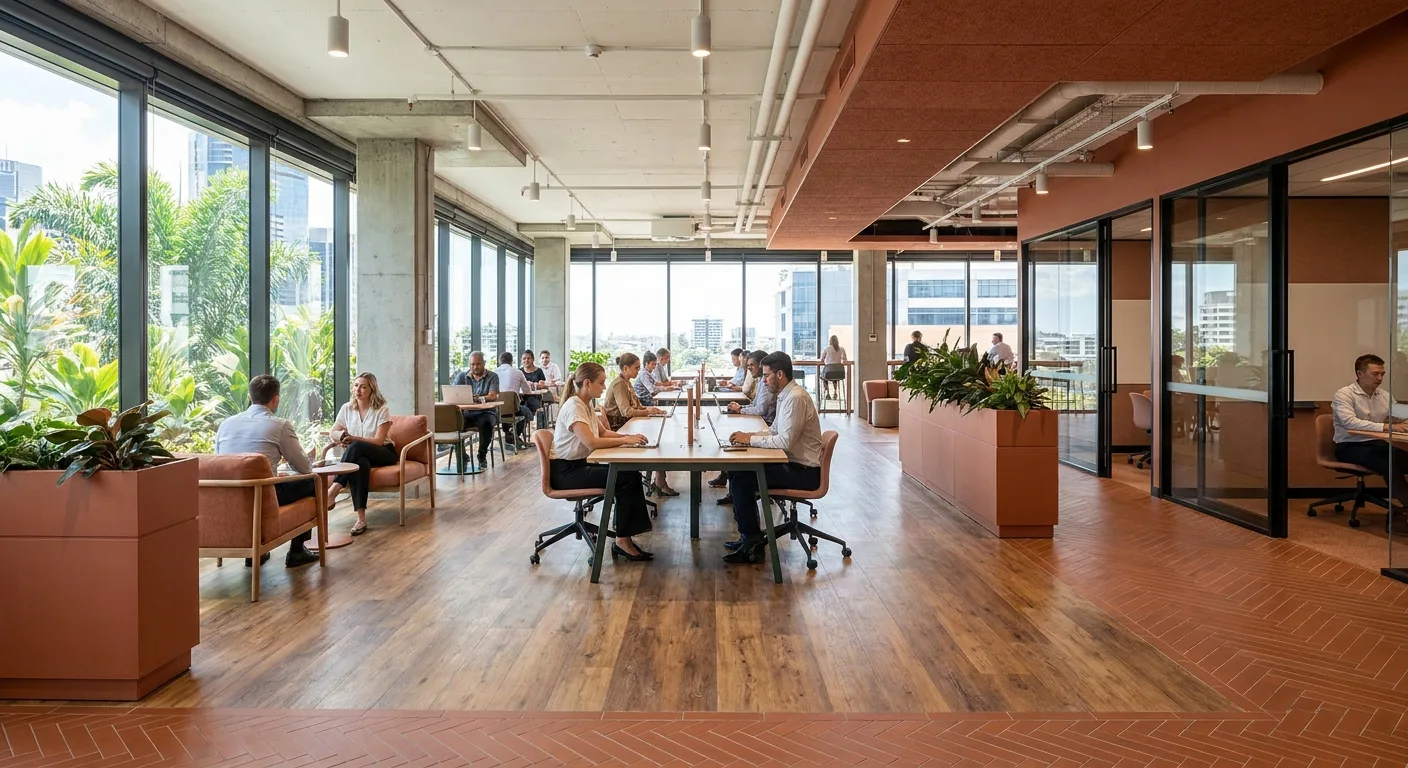
- Herringbone and chevron patterns in hospitality and boutique retail
- Concrete and terrazzo looks in industrial-style cafes and coworking spaces
- Light oak and blonde timber tones that brighten interiors
The shift from carpet to LVP is particularly pronounced in office fit-outs. Businesses cite easier cleaning, better durability, and a more modern aesthetic as the main drivers. Though carpet tile retains a strong role in areas where acoustic performance is a priority.
Trend 2: Sustainability Is Now a Specification Requirement
Five years ago, sustainability was a nice-to-have. Today, it is a procurement requirement for many southside businesses, particularly those in healthcare, education, and government-adjacent sectors.
Flooring products are being assessed on:
- Recycled content in the product and packaging
- VOC emissions (volatile organic compounds that affect indoor air quality)
- End-of-life recyclability through take-back programs
- Environmental product declarations (EPDs) that provide transparent lifecycle data
- Global GreenTag or Good Environmental Choice certification
Several major LVP and carpet tile manufacturers now offer products with over 50 per cent recycled content and zero-to-landfill programs. These products cost little or no more than conventional alternatives but tick the sustainability boxes that tenants and building owners increasingly demand.
Trend 3: Hybrid Zones and Mixed-Material Designs
The days of wall-to-wall single-material flooring are fading. Current southside fit-outs use multiple flooring types within a single space, each chosen for the zone it serves.
A typical modern office fit-out might include:
- LVP in reception, kitchen, and high-traffic corridors
- Carpet tile in open-plan work areas and meeting rooms
- Polished concrete or epoxy in server rooms and storage areas
A hospitality venue might combine:
- Engineered timber in the dining room for warmth and character
- Vinyl sheet in the kitchen for seamless hygiene
- Epoxy with anti-slip in the cool room and prep areas
This zonal approach gets the best performance from each material and creates visual interest through material transitions. It does require careful planning to ensure level transitions and edge details are handled cleanly.
Trend 4: Subfloor Quality Gets the Attention It Deserves
Older southside commercial buildings — particularly those in Woolloongabba, Annerley, Moorooka, and Rocklea — present subfloor challenges that newer buildings do not.
Common issues include:
- High slab moisture from inadequate or absent damp-proof membranes
- Surface irregularities from decades of use and previous flooring adhesive residue
- Cracking and movement in slabs that have settled over time
- Asbestos-containing adhesives in buildings from the 1960s to 1980s
Professional floor preparation has moved from an afterthought to a recognised critical step. More builders and project managers are allocating specific budget and time for subfloor assessment and treatment.
This is a positive shift. The single most common cause of commercial flooring failure is inadequate subfloor preparation. A $100-per-square-metre product installed on a poorly prepared slab will underperform a $60-per-square-metre product on a properly prepared one.
Trend 5: Speed of Installation Matters More Than Ever
Commercial tenants are paying rent from day one. Every day of fit-out is a day of paying for space they cannot use. This commercial reality is pushing demand toward products that install quickly.
LVP click-lock systems can cover 100 to 150 square metres per day with a two-person crew. Carpet tile is similarly fast. Both products require minimal acclimatisation time and can be walked on immediately after installation.
By contrast, hybrid flooring requires some acclimatisation, and epoxy systems need curing time. These products still have their place, but speed-sensitive projects often favour the faster alternatives.
Businesses planning commercial fit-outs are increasingly asking for installation timelines alongside price quotes, treating both as equally important decision factors.
What to Expect in the Next Twelve Months
Based on current project pipelines and industry direction, we expect to see:
- Continued LVP dominance in office and retail, with growing interest in stone and concrete looks alongside timber replicas.
- Increased demand for epoxy and resin in Logan’s industrial precincts as food processing and logistics facilities expand.
- More renovation work in established southside suburbs as older commercial buildings are upgraded for new tenants.
- Growing specification of acoustic underlays beneath hard flooring to address noise concerns without switching to carpet.
- Sustainability moving from preference to requirement as more tenants include it in lease negotiations and fit-out specifications.
Conclusion
Brisbane’s southside commercial flooring market reflects the broader transformation of the corridor. Businesses are choosing products that balance durability, aesthetics, sustainability, and speed of installation. LVP leads the way, but the smartest fit-outs use a combination of materials matched to each zone’s specific demands.
The common thread across all successful projects is professional preparation and installation. In a market where product quality is generally high across brands, the difference between a good outcome and a great one is the installer.
Fitting out a commercial space on Brisbane’s southside? Suelo Flooring supplies and installs across Woolloongabba, Annerley, Moorooka, Sunnybank, Springwood, and surrounding suburbs. Contact us for a site visit and quote.
Related Articles:
Suelo Flooring
Suelo Flooring delivers specialist commercial flooring across Southeast Queensland. An experienced, dedicated team manages every project from consultation to handover.
About Suelo Flooring